

If you’re researching product management training, you’ve probably noticed that many providers promote their courses as “certified”, “accredited” or “recognised”. At first glance, they can all sound similar. After all, most courses end with some form of certificate. Most providers talk about professional development. Most claim to help you become a better product manager.
So how do you tell the difference?
The answer lies in looking beyond the certificate itself. Because when it comes to professional development, the real question isn’t: “Will I receive a certificate?” It’s “What does that certificate actually represent?” Understanding that distinction can help you make a far more informed decision when choosing a product management course.
The Short Answer
Accreditation is not primarily about the certificate. It is about the quality, structure, relevance and delivery of the training programme behind that certificate. A non-accredited course may still contain useful content. An accredited course provides additional reassurance that the programme has been independently reviewed against recognised standards. That independent validation is often what separates a certificate of attendance from a recognised professional development credential.
Why Accreditation Exists
Professional training exists to help people develop new skills, improve performance and grow their careers. But how can learners, employers and organisations know whether a course delivers genuine value? This is where accreditation plays an important role. Accreditation provides independent review and validation of a training programme. Rather than simply relying on the provider’s own claims, an external organisation evaluates the course against recognised standards.
The purpose is to provide confidence that the programme is:
- Professionally structured
- Relevant to the subject area
- Delivered appropriately
- Designed around meaningful learning outcomes
- Suitable for professional development
In other words, accreditation helps answer an important question: “Can I trust the quality of this training?”
Accreditation Is a Quality Signal
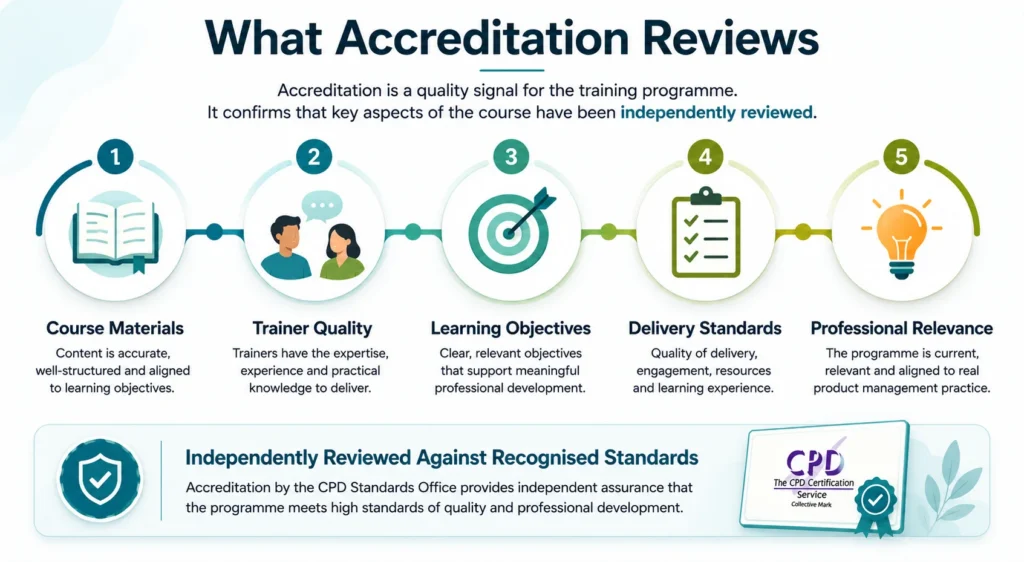
Many people assume accreditation is about the participant. In reality, it is often more accurate to think of accreditation as a quality signal for the programme itself. When a course is independently accredited, it provides reassurance that key aspects of the training have been reviewed and validated. This includes areas such as course structure, learning objectives, trainer expertise, professional relevance and overall delivery standards. The accreditation does not simply validate a piece of paper. It validates the training experience behind it.
Not All Certificates Are Equal
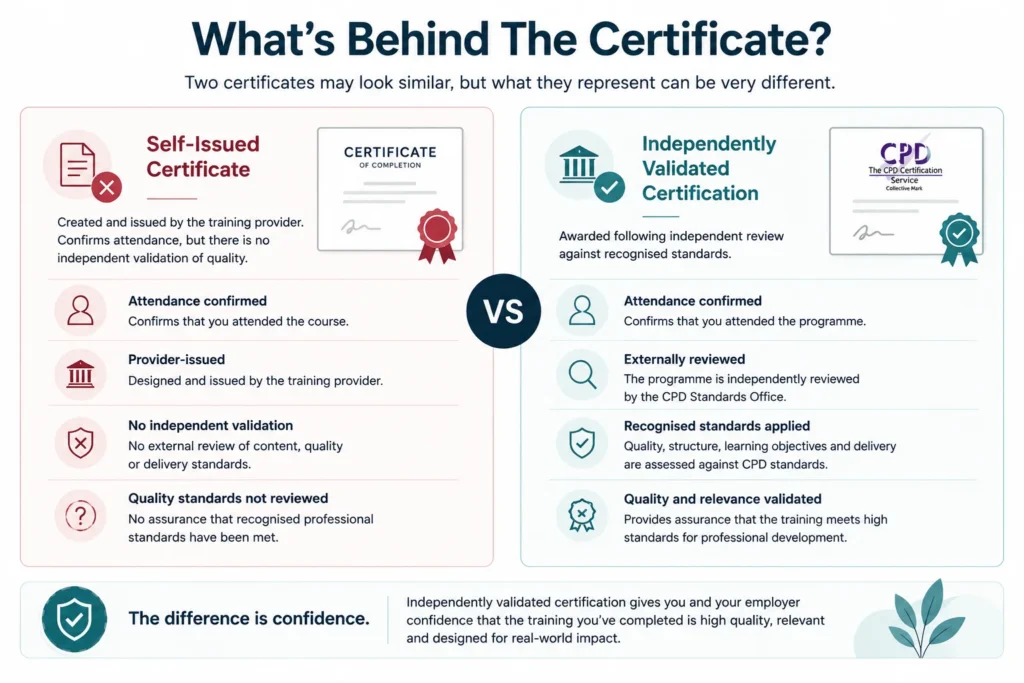
This is perhaps the most important point for professionals comparing training providers. Many certificates look almost identical. They often contain:
- A course title
- A participant name
- A completion date
- A provider logo
But what sits behind those certificates can vary enormously. Some certificates are simply created and issued by the training provider. They confirm that someone attended a course. There is nothing inherently wrong with that. However, the certificate itself does not necessarily tell you anything about the quality of the training, the relevance of the content or the standards used to design and deliver the programme. Other certificates are supported by independent accreditation. In these cases, the certificate represents more than attendance. It reflects training that has been externally reviewed against recognised professional development standards. That distinction matters. Particularly for organisations investing in team development and professionals seeking training that carries greater credibility.
Why This Matters To Employers
Most employers are not impressed by certificates alone. What they really want to know is:
- Was the training relevant?
- Was it professionally delivered?
- Was the content current?
- Did the programme follow recognised standards?
A certificate cannot answer those questions on its own. Accreditation helps. It provides employers with additional confidence that the learning experience has been independently reviewed and designed around recognised professional development principles. For organisations investing in product management capability across teams, this reassurance can be particularly valuable.
The Role of CPD Standards Office Accreditation
At Tarigo, our product management courses are accredited by the CPD Standards Office. This accreditation reflects the quality and professionalism of the training programmes themselves. The review process considers areas such as:
- Course content
- Learning objectives
- Programme structure
- Professional relevance
- Training delivery
This means participants can be confident they are receiving training that has been independently reviewed against recognised continuing professional development standards. Importantly, the accreditation is not simply attached to the certificate at the end. It applies to the quality of the entire learning experience.
Looking Beyond The Badge
When comparing product management courses, accreditation should be considered alongside several other important factors. For example: Who are the trainers? How current is the content? Does the programme reflect modern product management practice? Will the learning be relevant to your role and challenges? Does the provider specialise in product management?
Accreditation is valuable, but it is most powerful when combined with high-quality training, experienced practitioners and content that reflects how product management works in the real world.
Why Product Professionals Should Care
Product management is a practical discipline. Success depends on judgement, communication, prioritisation, stakeholder management and decision-making. Training should support those capabilities. Accreditation helps provide confidence that the programme has been designed to support meaningful professional development rather than simply delivering information. That is why many professionals increasingly look beyond the certificate itself and focus on the quality of the learning experience behind it.
Final Thoughts
When comparing accredited and non-accredited product management courses, the most important question is not whether you receive a certificate. The more useful question is: What does that certificate actually represent? A certificate may simply confirm attendance. Accreditation provides additional assurance that the training programme itself has been independently reviewed and designed to recognised standards. Ultimately, accreditation is not about collecting credentials. It is about confidence.
- Confidence in the quality of the content.
- Confidence in the expertise of the trainers.
- Confidence in the relevance of the material.
And confidence that your professional development is built on recognised standards rather than marketing claims.
Explore Tarigo’s Accredited Product Management Training
If you’re looking for product management training that combines practical learning with independently accredited professional development, explore our Product Management Certification pathway.