
If you’re asking whether a product management course certification is worth it in 2026, you’re already ahead of most candidates. Not because you’re looking for a course. But because you’re questioning whether it actually makes a difference. And that’s where most people get it wrong. They don’t ask whether certification is valuable. They assume it is. They pick a course, complete it, add it to their CV, and expect it to move the needle. In many cases, it doesn’t. Not because course certification has no value, but because most certifications don’t prove anything that employers care about. So the real question isn’t whether certification is worth it. It’s whether the course you choose actually reflects how product management works in practice.
Why This Question Matters More in 2026
Five years ago, having a product management course certification was relatively uncommon. It could signal initiative. It showed you had taken time to learn the discipline. That’s no longer the case. Today, hiring managers regularly see candidates who have:
- completed multiple online courses.
- followed well-known frameworks.
- can talk confidently about product theory.
And yet still struggle when asked a simple question in an interview “How would you prioritise this?” That gap between knowledge and application is exactly why the value of course certification is now under scrutiny. The market hasn’t just become more competitive. It’s become more selective.
Is Product Management Certification Necessary to Become a Product Manager?
No. Product management certification isn’t a mandatory requirement for becoming a product manager.
People move into product management from a wide range of backgrounds, including technology, marketing, UX, project management, business analysis, sales and customer-facing roles.
Practical experience is an important part of becoming an effective product manager, and there are many ways to develop that experience.
However, structured training can be particularly useful if you’re changing career direction, taking on product responsibilities for the first time or looking for a structured way to develop particular capabilities.
Certification should therefore be seen as one part of professional development, rather than a requirement for entering the profession.
Do Employers Value Product Management Certification?
In a real product management interview, you are rarely asked “What product management certification do you have?” Instead, you’re asked:
- “What would you do if stakeholders disagree on priorities?”
- “How do you decide what not to build?”
- “How do you know if a feature is worth it?”
These are not theoretical questions. They are judgement questions, they test how you think, how you structure decisions, how you handle ambiguity and this is where most courses fall apart. Because watching content about prioritisation is not the same as making a prioritisation decision under pressure, with incomplete information and competing stakeholder demands. Hiring managers know that. So when they see a certification, they are not asking “Did this person complete a course?” they are asking “Does this mean they can actually do the job?”
The Two Types of Course Certification (And Why the Difference Matters)
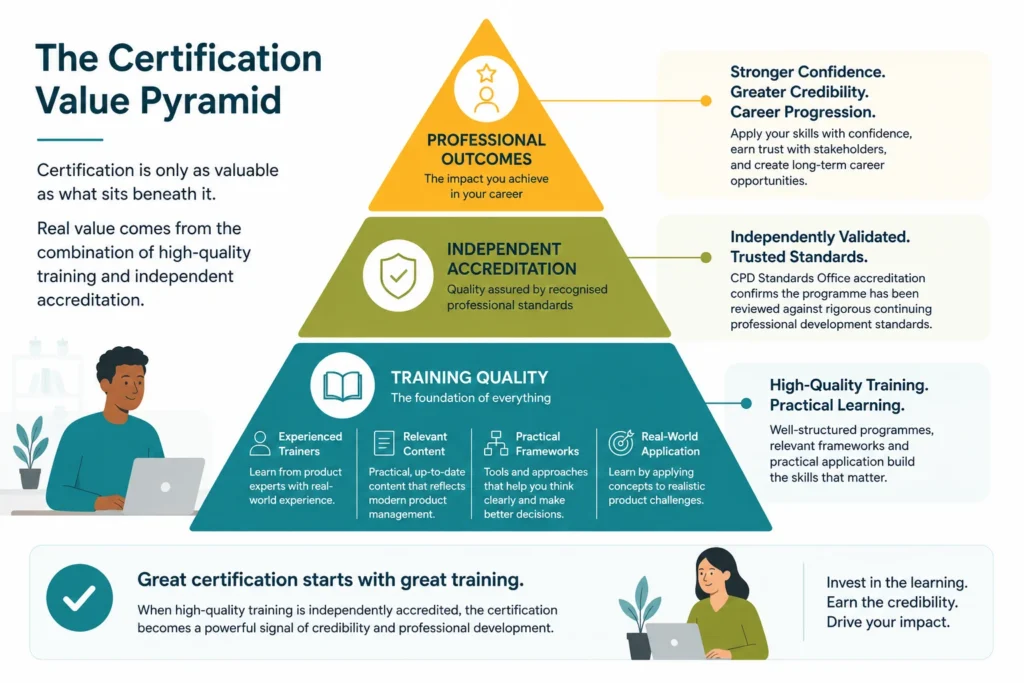
Not all product management certifications are equal. In fact, the gap between them is wider than most candidates realise. On one end, you have completion-based certifications. These are typically self-paced, content-heavy or lightly assessed (if at all). You watch modules, complete quizzes, and receive a certificate. They are accessible. They are often well-marketed. But they rarely change how someone operates in a product role. On the other end, you have structured, professionally delivered and independently accredited training programmes. These programmes focus on helping professionals develop stronger product thinking while providing certification that reflects recognised training standards. These are built differently. They focus on application, not just theory and require you to think through real scenarios. The difference is not academic. It’s practical. One gives you exposure to product management. The other develops capability.
When is Product Management Certification Worth It?
Certification becomes valuable when it closes a gap that experience alone cannot. For example, if you’re moving into product management from another role, the challenge is rarely motivation. It’s structure. You may already have transferable skills. You may understand customers, delivery, or stakeholders. But without a structured way of thinking about product decisions, interviews become difficult. This is where a strong certification helps. It gives you:
- a consistent framework.
- a way to explain your thinking.
- a clearer understanding of trade-offs.
That shows up immediately in interviews. The same applies if you’re early in your product career. Many junior product managers learn reactively. They pick things up from teams, from managers, from trial and error. Over time, this creates inconsistency. A good course doesn’t just add knowledge. It removes that inconsistency. It replaces guesswork with structured thinking.
If You’re An Experienced Product Manager
Training isn’t only useful when you’re starting out. For an experienced product manager, certification may help fill gaps in knowledge, challenge established ways of working or develop a particular capability. The value comes from finding training that addresses what you actually need to develop, rather than simply adding another qualification to your CV.
If You’re Moving into Product Leadership
The skills required at a more senior level can extend beyond managing an individual product. You may need to think more broadly about product strategy, teams, organisational alignment and wider business objectives. The right training can provide a structured way to develop those capabilities, particularly when moving from product management into product leadership.
When It’s Not Worth It (And Why Many People Go Wrong)
The easiest way to waste money on a course is to treat it as a shortcut. It isn’t. If you choose a course based purely on price, brand name or convenience, you’re likely to end up with something that feels productive, but doesn’t translate into real improvement. A common pattern looks like this: A candidate completes a course. They feel more confident. They update their CV. They apply for roles. Then they reach interview stage and realise they can’t apply what they’ve learned in a real scenario. That’s not a failure of effort. It’s a failure of how the course was designed. Another common mistake is assuming course can replace experience. It can’t. What it can do is make your experience more effective. It sharpens how you think. It improves how you make decisions. But it doesn’t remove the need to demonstrate impact.
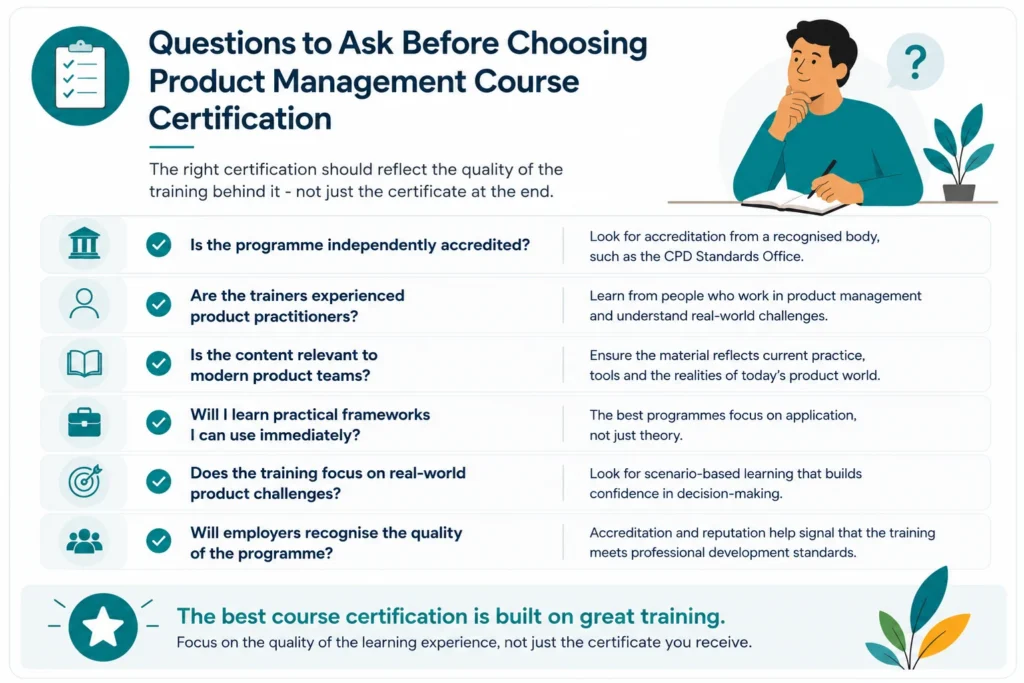
What Makes a Good Product Management Certification?
The value comes from the quality of the training and the credibility of the accreditation.
There are a few signals that consistently separate strong courses from weak ones.
Practical application
If everything you do in a course is theoretical, it won’t hold up in practice. You need to be working through scenarios that reflect real product decisions, not idealised versions of them. Look for opportunities to develop skills such as:
- understanding customer and market needs.
- identifying and evaluating opportunities.
- product discovery.
- prioritisation.
- product strategy.
- road mapping.
- stakeholder management.
- communicating product decisions.
- making decisions using evidence and insight.
The ability to apply a technique is generally more useful than simply being able to describe it.
Is the content up to date?
Product management continues to evolve. Modern product teams may work across discovery, strategy, delivery, experimentation, commercial outcomes and cross-functional collaboration. AI is also becoming increasingly relevant to everyday product management practice. When comparing courses, look at when the content was last updated and whether it reflects current product management challenges.
Is the course right for your experience level?
A certification isn’t automatically more valuable because it is more advanced. The important thing is whether the programme matches your current experience and development goals. You might be:
- moving into your first product management role.
- an early-career product manager.
- an experienced product manager looking to broaden your skills.
- moving into product leadership.
- responsible for developing product capability across a team or organisation.
A course aimed at someone new to product management won’t necessarily provide what an experienced product leader needs.
Experienced practitioners
Consider who has designed and delivers the training. Product management is a practical discipline, so relevant experience can help trainers put concepts and frameworks into context. Look at the experience of the people delivering the programme and whether their expertise is relevant to the type of product management you’re looking to develop.
How is the certification assessed?
Don’t just look at whether a course offers a certificate. Find out what you actually have to do to earn it. Some programmes are based largely on attendance or knowledge checks, while others require you to demonstrate your understanding through assessments or practical application. Ask:
- Is there an assessment?
- What does it test?
- Is it based on knowledge, practical application, or both?
- Do you need to demonstrate your understanding?
- What does the final certification actually confirm?
The important question is what the certification actually demonstrates.
Completing a course shows that you’ve undertaken the training. A meaningful assessment can provide stronger evidence that you’ve understood and can apply what you’ve learned.
Accreditation
This is often overlooked, but it matters. Independent accreditation introduces a level of accountability. It signals that the course meets defined standards, rather than simply being self-declared.
In the UK, CPD accreditation provides independent validation that a training programme has been reviewed against recognised continuing professional development standards. This gives learners and employers greater confidence in the quality, relevance and structure of the training being delivered.
The Real ROI: What Actually Changes
When product management training works, the impact is not abstract. It shows up in how you operate. You become more deliberate in how you prioritise. You can explain trade-offs more clearly. You stop relying on instinct alone and start using structured reasoning. This has a direct effect on interviews. Instead of giving vague answers, you can walk through your thinking step by step. That’s often the difference between a “good” candidate and a “hire”.
It also affects progression. Product managers who can articulate decisions and handle complexity tend to gain trust faster. That leads to more ownership, which leads to faster growth. The certification itself doesn’t create that outcome. But the capability it builds does.
Product Management Certification vs Experience
Certification and experience aren’t alternatives.
Training can provide frameworks, techniques and knowledge. Experience gives you the opportunity to apply those things to real products, customers, teams and business challenges. The strongest development approach may combine both. For example, someone moving into product management might use formal training to build their foundation while developing practical experience through their role. An experienced product manager might use training to develop a particular capability and then apply it immediately to a current product challenge.
The certificate is evidence of learning. The ability to apply that learning is what makes it useful.
What Should Employers Consider When Choosing Product Management Training?
Rather than asking simply whether a certification is recognised, employers should consider whether the training addresses the skills their product managers actually need.
Questions to consider include:
- Is the programme appropriate for different experience levels?
- How practical is the training?
- Can learners apply the techniques to current product challenges?
- How does the learning fit with the organisation’s product approach?
- What resources or support are available after the course?
- How will the impact of the training be measured?
Certification can provide useful evidence of structured learning, but organisations should also consider how the training translates into day-to-day product practice.
So, Is It Worth It?
There isn’t a universal answer. For some people, formal certification can provide a useful structure for developing product management skills, particularly when moving into product management, filling knowledge gaps or progressing into a more senior role. For others, practical experience or targeted development may be more appropriate.
If you’re considering certification, look beyond the certificate itself. Consider:
- What skills will you develop?
- Is the programme appropriate for your experience?
- How practical is the learning?
- Who is delivering it?
- How are you assessed?
- What does the certification demonstrate?
- Is the programme accredited or independently recognised?
- How will you apply what you’ve learned?
- Does the overall investment make sense for your career or organisation?
The right product management certification should give you more than another line on your CV. It should help you develop capabilities you can put into practice. The certificate matters. But what you can do because of the training matters more.
Final Thought
Certification can accelerate your move into product management. It can sharpen your thinking. It can improve how you perform. But only when it reflects the reality of the role. That’s the difference between something that sits on your CV and something that actually changes your trajectory.
Ready to Take the Next Step?
If you’re serious about building real product management capability, the focus shouldn’t be on collecting certificates. It should be on choosing a programme that actually changes how you think and operate. That means looking beyond surface-level learning and asking “Will I be pushed to make real product decisions?”, “Will I be challenged on how I think?”, “Will I leave with the confidence to handle interviews and the role itself?”. Because that’s what ultimately moves the needle. At Tarigo, that’s exactly what our Product Management Bootcamp is designed to do. It’s CPD-accredited, but more importantly, it’s built around real-world product scenarios, the kind you’ll face in interviews and on the job.
You won’t just learn frameworks. At Tarigo, our Product Management Bootcamp combines practical product management training with CPD-accredited certification. Participants learn from experienced practitioners, work through real-world product challenges, and leave with frameworks they can apply immediately within their organisations. The certification reflects the quality and professional standards of the training programme. The training itself helps build confidence, capability and credibility. So if you’re ready to move beyond theory and invest in something that genuinely builds capability, it’s worth taking a closer look at how Tarigo approaches product management training.