
30 Second Overview
Most product organisations agree that skills matter. They understand that capability shapes performance, influences product quality and affects how well teams collaborate and deliver. Yet when it comes to assessing those skills, many rely on guesswork, informal conversations or outdated tools that tell them very little about what is really happening inside the team.
Skills assessment should be a powerful lever for improvement. Too often, it fails to deliver the insight leaders need. Understanding why is the first step toward fixing the problem.
1: Assessments focus on activity, not outcomes
Many teams look at training attendance, role responsibilities or outputs as a proxy for capability. A product manager who writes user stories is assumed to understand requirements. Someone involved in roadmap work is assumed to be strategic. These assumptions rarely reflect reality.
True capability is about behaviours, judgement and the ability to make good decisions under pressure. Most assessments do not measure these qualities. As a result, they give an incomplete picture that does not help leaders determine where improvement will create meaningful outcomes.
2: Assessments are often generic and disconnected from context
A common weakness in skills assessments is the use of generic models that do not reflect the organisation’s goals or the realities of its market. When every product manager is evaluated against the same universal checklist, the result is a flat, context free score.
This creates two problems. First, teams cannot see which skills matter most for their business. Second, individuals receive development suggestions that feel vague or irrelevant. Without clear relevance, engagement with development quickly drops.
3: Assessments give you data, but not direction
Some assessments produce attractive dashboards or detailed reports. Leaders receive charts and summaries that look impressive but do not answer the most important question: what should we do next?
Without focused recommendations, data becomes another burden to interpret. Leaders try to translate scores into decisions. Individuals are left to guess how to improve. The outcome is a lot of information but very little action.
4: No visibility of variation across the team
Even high performing teams have uneven strengths. Some excel in customer insight, others in commercial thinking or delivery execution. Most assessments fail to show these variations. They treat the team as a single average, which hides risk and prevents targeted development.
When variation is invisible, training becomes scattergun and leaders miss opportunities to build balanced, complementary teams.
5: No way to track improvement over time
One assessment tells you where you are today, but not whether capability is improving. Skills grow slowly and unevenly. Without a way to measure progress, leaders cannot demonstrate the value of training or refine their development strategy.
A better approach to product capability assessment
If skills assessment is going to support real performance improvement, it must solve these problems. It needs to be context aware, actionable, linked to outcomes and able to show change over time. Above all, it must provide clarity, not more guesswork.
This is why Tarigo created GAIN.
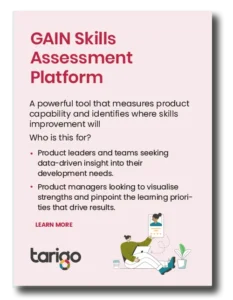
GAIN is an AI driven skills assessment built specifically for product teams. It shows where capability is strong, where it is exposed and which improvements will deliver the greatest impact. Results are aligned to business objectives, so development becomes targeted and meaningful. Leaders also get visibility of team variability and the ability to track capability growth over time. Individuals receive personalised development actions.
Most assessments give you data. GAIN gives you direction.